
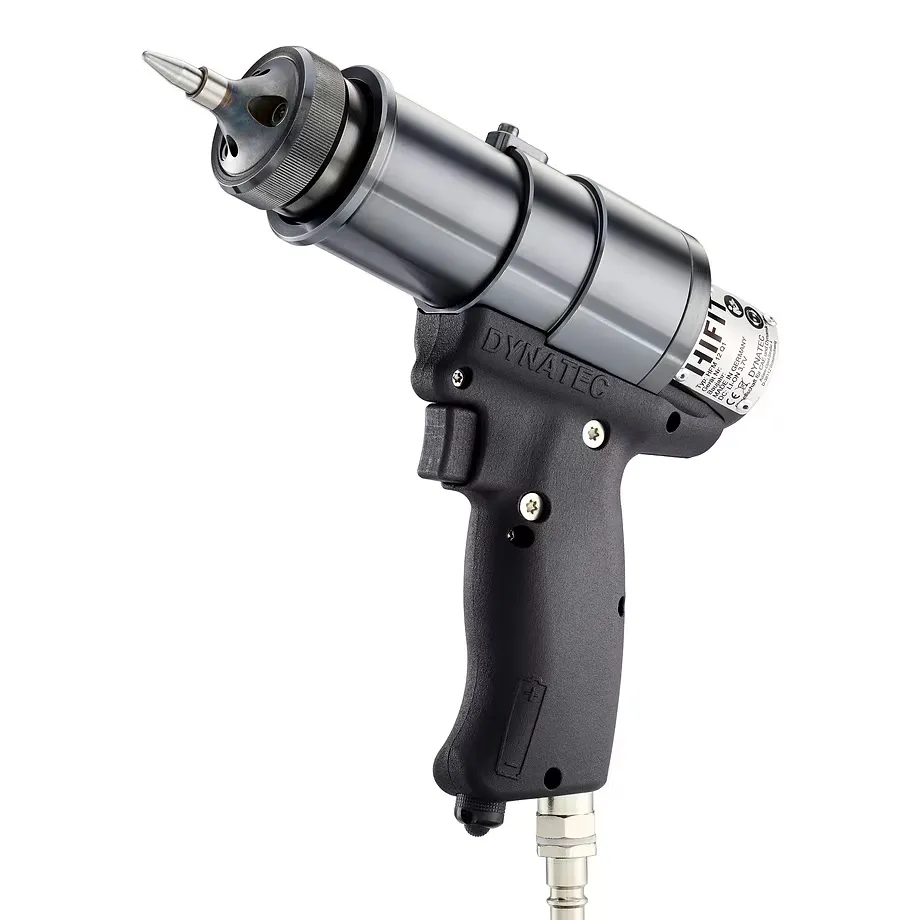
Weld Fatigue Treatment (HFMI)
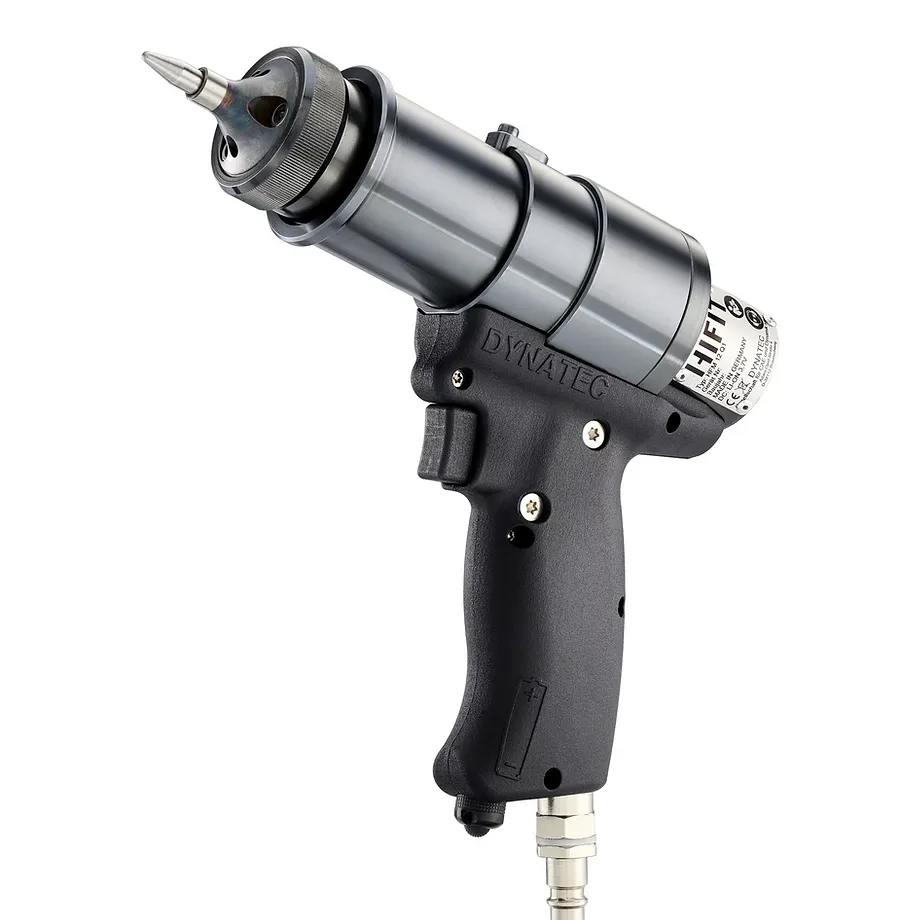
HiFIT is a 1.8 kg pneumatic hammer that reshapes the weld toe in a single pass. No heat input, no consumables, and full IIW design credit on steel up to S1300.
Made in Germany by HiFIT Vertriebsgesellschaft mbH · US distribution by Inmotion, Jacksonville FL
The sharp transition where weld meets plate concentrates stress and locks in tensile residual stress from welding. Under cyclic load, that's where the crack begins.
The sharp weld-to-plate transition concentrates stress right where the metal is most vulnerable.
As-welded toes sit in tensile residual stress, +185 to +552 MPa, which pulls fatigue cracks open.
Grind a crack out and it comes back. On a busy structure, a detail can crack every 18 months.
Left untreated, the joint's fatigue class limits how much load, or how high a steel grade, you can credit.
HiFIT treats the toe directly, so the crack never gets a place to start.
A 3 mm hardened pin presses a smooth groove, 0.2 to 0.6 mm deep, where the weld meets the plate. That cuts the stress concentration about 31% and blunts the spot where cracks start.
An as-welded toe sits in tension. HiFIT drives the surface into compressive residual stress, down to -630 MPa, so it squeezes cracks shut instead of pulling them open.
Cold-working refines the grain and raises surface hardness about 10%, so the treated toe holds up longer than the metal around it. All three happen in one slow pass, with no heat input.
| Dimension | HiFIT (HFMI) | Grinding / TIG / shot peening |
|---|---|---|
| Mechanism | Geometry + compression + hardening | One mechanism each (geometry or stress) |
| FAT class improvement (IIW) | 4 to 8 classes | 1 to 2 classes |
| Fatigue life extension | 5 to 15x | 1.5 to 3x |
| Depth of effect | 1.3 to 2.0 mm | 0.2 to 0.5 mm, or surface only |
| Heat input | None | TIG dressing re-melts the toe |
| Consumables | None | Shot, gas and electrodes, or discs |
| Portability | 1.8 kg handheld on shop air | Cabinet, TIG rig, or grinder |
Mechanism
HiFIT (HFMI)
Geometry + compression + hardening
Grinding / TIG / shot peening
One mechanism each (geometry or stress)
FAT class improvement (IIW)
HiFIT (HFMI)
4 to 8 classes
Grinding / TIG / shot peening
1 to 2 classes
Fatigue life extension
HiFIT (HFMI)
5 to 15x
Grinding / TIG / shot peening
1.5 to 3x
Depth of effect
HiFIT (HFMI)
1.3 to 2.0 mm
Grinding / TIG / shot peening
0.2 to 0.5 mm, or surface only
Heat input
HiFIT (HFMI)
None
Grinding / TIG / shot peening
TIG dressing re-melts the toe
Consumables
HiFIT (HFMI)
None
Grinding / TIG / shot peening
Shot, gas and electrodes, or discs
Portability
HiFIT (HFMI)
1.8 kg handheld on shop air
Grinding / TIG / shot peening
Cabinet, TIG rig, or grinder
Each FAT class is roughly a 12.5% increase in allowable stress range (per IIW), and the benefit climbs with steel strength.
| Steel grade | Yield strength | FAT improvement | Life extension | Notes |
|---|---|---|---|---|
| S355 | ≤ 355 MPa | +4 classes | 5–8x | Baseline improvement per IIW |
| S460 | 460 MPa | +4.5 classes | 6–9x | +0.5 class per 200 MPa over 355 |
| S550 | 550 MPa | +5 classes | 7–10x | Common in bridges and offshore |
| S690 | 690 MPa | +6 classes | 8–12x | Cranes and mining (recommended) |
| S960 | 960 MPa | +8 classes | 10–15x | Maximum documented benefit |
Full benefit applies at stress ratio R ≤ 0.15. Higher ratios use the IIW correction factors. Applicable to S1300, with fatigue benefit documented through S960.
The original HFMI use case. Treating fatigue-critical connection details extends remaining life 5 to 10x and can defer a deck or member replacement by decades.
Tower-to-foundation connections and internal ring-flange welds in S460 and S690. HFMI lets the design book full credit for the higher-strength steel.
Tubular joints on jackets and monopiles carry the worst fatigue loading on the structure. HFMI adds DNV-recognized life, paired with proper corrosion protection.
Frames, booms, and structural members. Applied during scheduled maintenance, it ends the crack-recurrence cycle.
HiFIT is made in Germany by HiFIT Vertriebsgesellschaft mbH and supported in the US by Inmotion.
One repair weld costs more than the treatment, A fatigue crack on a structural connection means inspection, grinding, a repair weld, and downtime. A single avoided repair on a bridge or crane covers the tool.
Book the credit on paper, ISO 23555 covers how to apply the treatment and prove it. The IIW Recommendations (2nd edition, 2024) set how much fatigue credit your engineer can claim in the design. You need both, and HiFIT is built for both.
US support and operator qualification from Inmotion, Sold and supported from Jacksonville, FL, including help qualifying operators per ISO 23555 for structural work.
| Operating frequency | 180–300 Hz |
|---|---|
| Air pressure | 6–8 bar |
| Device weight | 1.8 kg |
| Pin diameter | 3 mm (hardened steel) |
| Groove depth | 0.2–0.6 mm |
| Treatment speed | 5–20 mm/s |
| Plastic deformation depth | 1.3–2.0 mm |
| Compressive residual stress | Up to −630 MPa |
| Compatible materials | Structural and high-strength steel up to S1300 |
| Standards | IIW Recommendations for HFMI (2nd ed, 2024) · ISO 23555 |
| Manufacturer | HiFIT Vertriebsgesellschaft mbH, Germany |
Roughly 1 to 3 minutes per meter of weld, at a treatment speed of 5 to 20 mm/s. The device is 1.8 kg and runs on shop air at 6 to 8 bar.
The reshaped geometry and surface hardening are permanent, and the compressive residual stress is stable under normal loading. Above stress ratio R = 0.5 or under overload, some relaxation can occur. The IIW recommendations include correction factors for that.
Per ISO 23555: visual inspection for groove uniformity, depth measurement with a groove gauge, and documentation of the treatment parameters. Structural work also requires operator qualification, and some applications add hardness testing.
Tell us the structure and the steel grade, and we'll send a configured quote with the design-credit data your engineer needs.
5 to 15x more fatigue life in one pass. Treat the weld toe directly and book the IIW design credit instead of over-building the joint.
No consumables, no heat input. 1.8 kg on shop air. No shot, gas, or discs to restock, and no distortion from added heat.
Made in Germany, supported in the US by Inmotion. Quotes, delivery, and operator qualification from Jacksonville, FL, without overseas lead times.
A US-based specialist will get back to you within 1 business day.
Thanks, we've got it.
A US-based specialist will be in touch within 1 business day.
Prefer to talk now? → +1 312 547 9253 · office@inmotion.global